How to Hire an SEO Copywriter in 2026: The Complete Playbook

You can hire an SEO copywriter in 48 hours if you know where to look. Upwork, LinkedIn, niche job boards, and direct outreach to writers whose work already ranks. The faster question is whether the person you hire will actually produce content that ranks, or just content that gets delivered on time.
This is the playbook. Every step covers what to do, what to ask, and what the common failure looks like. Use it whether you are hiring a freelancer for one post or an agency for an ongoing retainer.
Step 1: Write the brief before you write the job ad
The single biggest reason new hires fail is that the business owner did not know what they wanted before they started looking. A good SEO copywriter can only be as good as the brief they work from.
Before you post anywhere, write a one-page brief that answers:
- What is the primary keyword we want to rank for?
- What is the keyword difficulty (KD) and monthly search volume?
- Who is the reader? What problem are they trying to solve?
- What action do we want them to take after reading?
- What internal pages should this post link to?
- What is our brand voice (formal, direct, conversational)?
If you cannot answer these questions yourself, you are not ready to hire an SEO copywriter. You need a strategist first. A writer cannot invent a keyword strategy on a $300 project budget.

Step 2: Decide where to look
The right sourcing channel depends on your budget and the quality you need.
| Channel | Budget | Quality range |
|---|---|---|
| Upwork, Fiverr | $50 to $300 per post | Very mixed. Most are AI-assisted. |
| Contently, ClearVoice, nDash | $200 to $800 per post | Vetted pool, mid-senior |
| LinkedIn direct outreach | $300 to $1,000 per post | Variable, but you control selection |
| Referrals from marketing Slack communities | $400 to $1,200 per post | Usually strong, always busy |
| Agencies (freelance vs agency details in our hire SEO copywriter comparison guide) | $750 to $5,000 per month | System + writer together |
If you need one post, freelance marketplaces work. If you need 4 to 10 posts per month and you do not have an in-house SEO lead, a retainer with an agency or a dedicated writer is almost always cheaper than managing four freelancers.
Step 3: Filter portfolios for ranking proof, not writing skill
Most SEO copywriter portfolios show polished writing samples. Polished writing is the baseline. You are paying for rankings, not prose.
When you review three candidates, ask each one for:
- Three live URLs they wrote that currently rank on page one of Google for a real commercial keyword.
- The exact keyword each one targets.
- A Google Search Console screenshot showing the ranking position over the last 90 days.
Writers who cannot produce this are selling writing, not SEO. That is fine for a blog about your founder story. It is not fine for content that is supposed to drive leads.
Red flag portfolio patterns:
- Every sample is on Medium or LinkedIn (those rank through platform authority, not the writer’s work)
- No mention of keywords, only topics
- “Featured in Forbes, Entrepreneur” with no links to the actual pieces
- Samples from 2019 or earlier (SEO has changed three times since then)
Step 4: Run a paid trial against a real keyword
Do not hire based on a sample pitch or a Loom intro. Run a paid 500-word trial.
Pick a low-stakes keyword you actually want to rank for (KD under 15, volume 50 to 500 per month). Give each shortlisted candidate the same brief. Pay them the equivalent of a half post, usually $75 to $200 depending on their rate.
What you are measuring in the trial:
- Did they follow the brief, or go off on their own?
- Did they find a search intent you missed?
- How many edits does the draft need before it is ready to publish?
- Did they include internal links without being told?
- How did they handle questions? Did they ask any at all?
The winner is the person whose draft needs the fewest edits and whose questions showed they understood your business. Not the most polished prose. Polish is cheap. Judgment is rare.
Step 5: Negotiate the contract terms that actually matter
Most SEO copywriter contracts focus on payment schedules and revision rounds. Those matter, but they are not where projects go wrong.
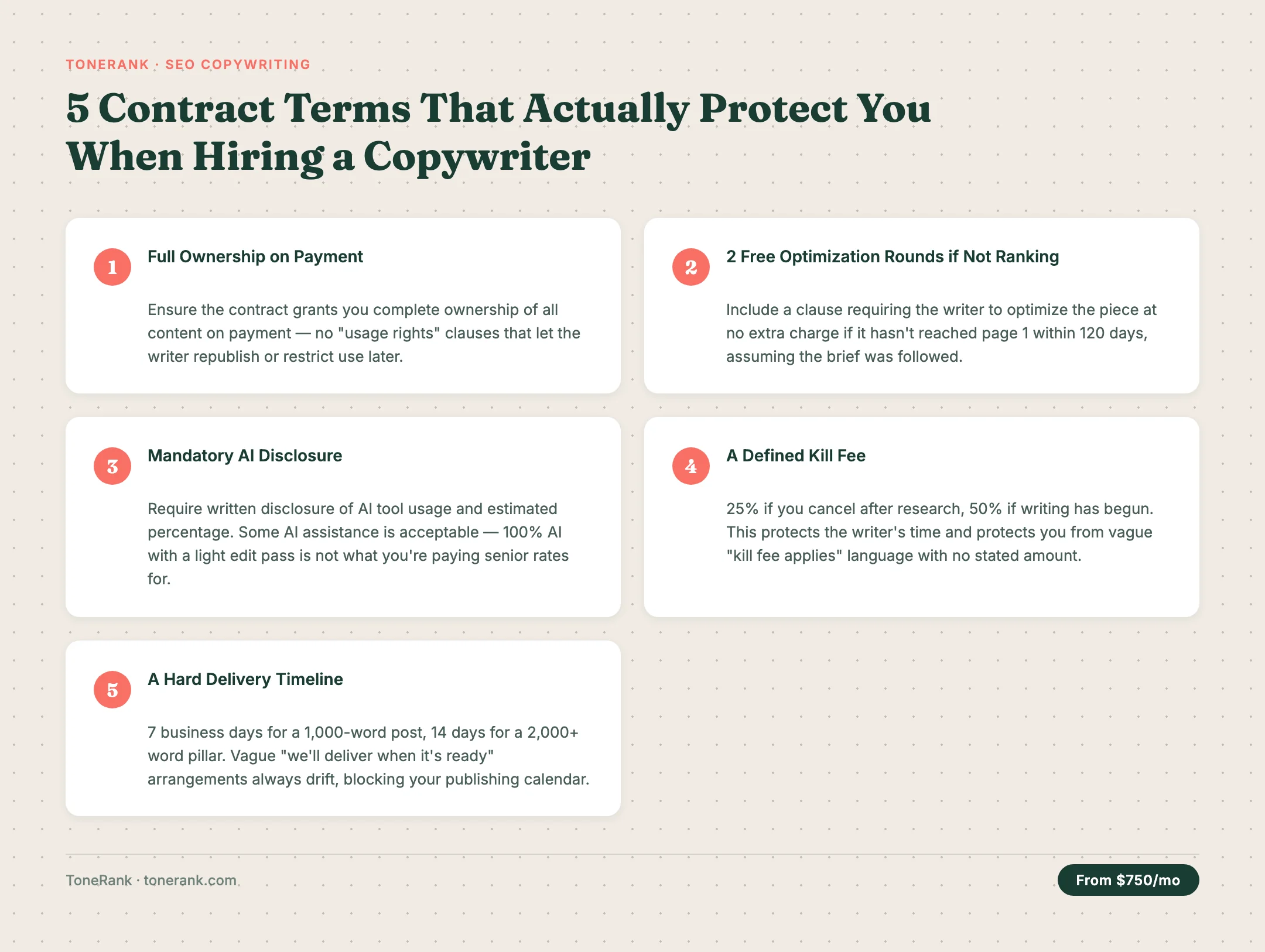
The terms that actually matter:
- Ownership and rights. You own the content outright on payment. No “usage rights” language.
- Ranking expectations. Include a clause: “Writer commits to 2 rounds of on-page optimization if the piece does not rank on page 1 within 120 days, assuming the brief was followed and technical SEO is in place.”
- AI disclosure. Writer must disclose whether AI tools were used and at what percentage. Some AI assistance is fine. 100% AI with a human edit pass is not what you are paying for.
- Kill fee. 25% kill fee if you cancel a piece after research is complete but before writing begins. 50% if writing has started.
- Timeline. 7 business days from brief to first draft for a 1,000-word post. 14 days for a pillar piece over 2,000 words.
If a writer pushes back on the ranking clause, ask why. Good writers accept it because they know their process works. Writers who refuse it are telling you something important.
Step 6: Price benchmarks for 2026
Here is what the market actually pays right now.
| Experience level | Per-word rate | Per 1,000-word post | Monthly retainer |
|---|---|---|---|
| Junior (under 2 years) | $0.10 to $0.20 | $100 to $200 | $500 to $1,500 |
| Mid (2 to 5 years) | $0.25 to $0.50 | $250 to $500 | $1,500 to $3,500 |
| Senior specialist | $0.60 to $1.00 | $600 to $1,000 | $3,000 to $6,000 |
| Agency (full stack) | Included | Included | From $750 to $5,000 |
The specialist rate (senior) is paying for keyword research, competitive analysis, internal linking strategy, and a writer who has ranked content in your niche before. The junior rate is paying for writing hours. Know which one you are buying.
A note on agencies: automation-first SEO copywriting agencies now deliver the full stack (audit, strategy, writing, reporting) at the low end of the agency retainer range. From $750 per month, flat fee, no lock-in. If you are weighing freelance versus agency, the pricing gap is narrower than it used to be.
Step 7: Onboard in 30 days, not 30 minutes
The final mistake: hiring an SEO copywriter and assuming they will produce great work from day one. They will not. Nobody does. Writers need context.
A 30-day onboarding plan that actually works:
Week 1: Share your brand guide, past analytics, keyword list, and top 10 competitor URLs. Record a 20-minute Loom walking through your business, your customer, and your past content. Have the writer produce a content brief (not a draft) for their first piece. You approve the brief before writing starts.
Week 2: First draft delivered. You give detailed edit feedback in Google Docs, not just a Slack “looks good” or “not quite.” Writer revises.
Week 3: Second piece in motion with the lessons from the first edit round. By now the writer should need fewer corrections.
Week 4: Review the first published post’s indexing status, any ranking movement, and whether the writer proactively flagged issues. This is where you decide to continue, scale up, or part ways.
Skip this and your $500 per post turns into a $5,000 slow-motion mistake.
Making the call
If you have the time and the strategy layer in place, hiring a freelance SEO copywriter is a good move. You get writing capacity at a per-post price and you keep full control of the pipeline.
If you do not have an SEO strategist, a content calendar, or the hours to manage a writer, hiring a freelancer is usually the more expensive choice. The posts get published. The rankings do not happen. The budget is gone.
For a full comparison of the freelance versus agency decision, read our honest comparison of hiring an SEO copywriter versus an SEO content agency. If you want a broader market view first, our guide to the best SEO content writers ranks the top services with a pricing and evaluation framework. If you already know you want the agency model at a predictable monthly rate, see if we are a fit.